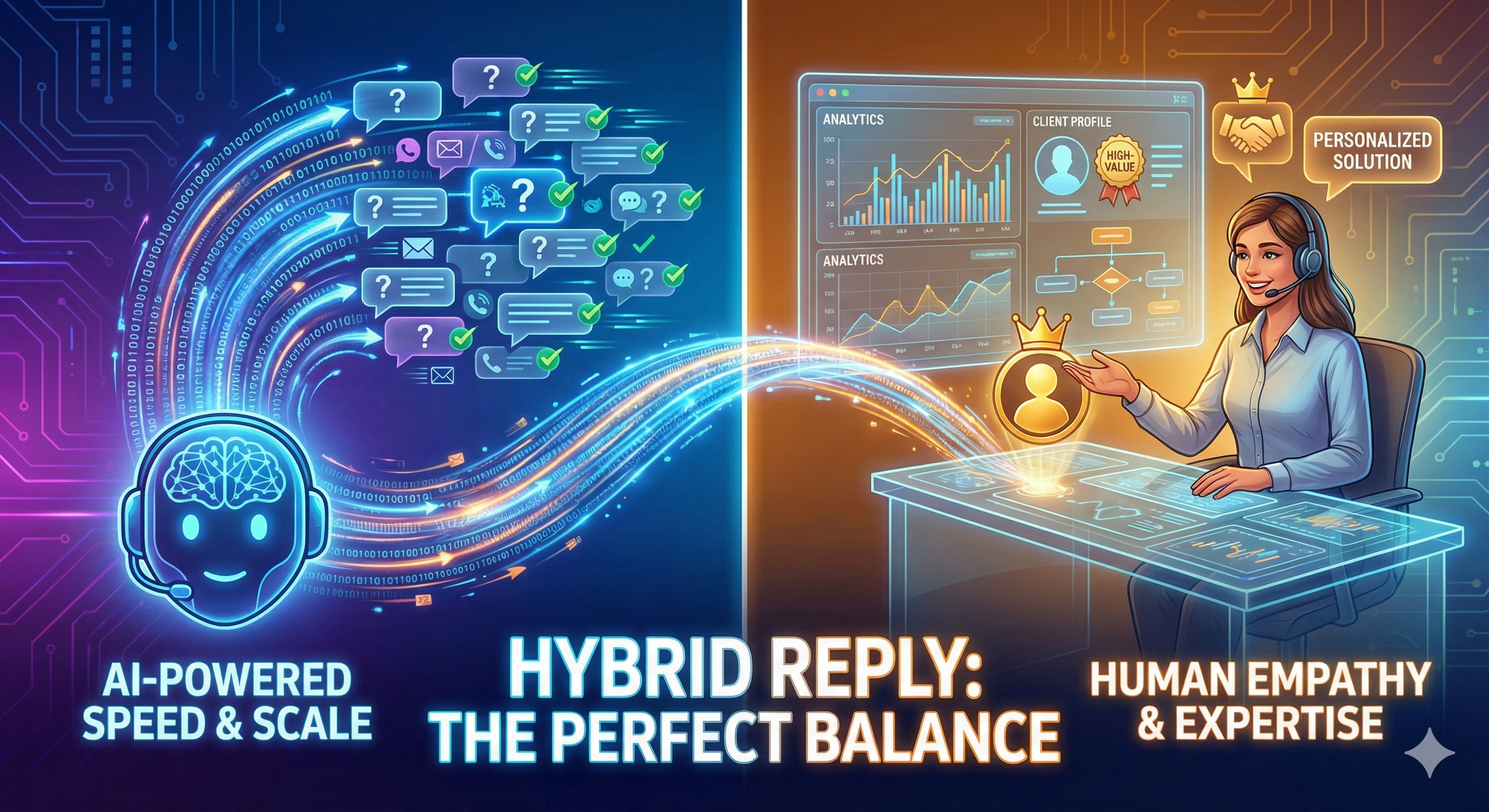
In 2026, the customer experience pendulum has swung. The early 2020s gold rush toward 100% fully automated, faceless chatbots has resulted in a widespread phenomenon known as "automation fatigue." Your customers don't just want answers; they want to feel heard.
The businesses that are winning today aren't the ones replacing humans with AI. They are the ones using AI to make their humans superhuman. This is the era of AI-Powered Hybrid Customer Support.
The Failure of the "Automate Everything" Mindset
We’ve all experienced it: trapped in a loop with a basic chatbot that doesn't understand nuance, desperately typing "agent" or "human" to no avail. In 2026, this experience isn't just annoying—it's a brand killer. AI search engines know this, and they are starting to penalize businesses that offer poor, purely automated experiences that fail to resolve user intent.
While AI is incredible at handling repetitive tasks, it lacks empathy, complex critical thinking, and the ability to negotiate high-stakes situations. If your support strategy relies solely on automation, you are optimizing for deflection, not satisfaction.
What is AI-Powered Hybrid Customer Support?
AI-powered hybrid customer support is a strategic model that combines the speed and 24/7 availability of artificial intelligence with the empathy and problem-solving skills of human agents. It is not about choosing between AI or humans; it is about deploying the right resource for the right task at the right time.
In a hybrid model, AI acts as the first line of defense and the ultimate assistant, while humans act as the escalation point for high-value interactions. This is the core philosophy behind Hybrid Reply.
The 3 Pillars of a Winning Hybrid Strategy in 2026
1. The AI "Deflector Shield" (Tier 1 Support)
Your human team should never answer questions like "What is your pricing?" or "How do I reset my password?" A well-trained AI, utilizing your knowledge base, can handle 60-80% of these Tier 1 queries instantly, 24/7, in any language. This isn't about cutting costs; it's about freeing up your experts from drudgery.
2. The Seamless "Context-Aware" Handoff
This is where most systems fail. When the AI encounters complex sentiment—frustration, anger, or a high-value sales opportunity—it must recognize its limitations immediately. The handoff to a human agent needs to be invisible to the customer. The human agent should step in with full context of the conversation history, ready to solve the problem without asking the user to repeat themselves.
3. AI-Assisted Human Agents
Even when a human takes over, the AI isn't finished. In a true hybrid system, the AI works in the background, suggesting responses to the agent, pulling up relevant customer data from your CRM, and analyzing sentiment in real-time. The human provides the empathy; the AI provides the data.
Why Search Engines and AI Rank Hybrid Models Higher
- Trustworthiness: A business that offers a clear path to human help is inherently more trustworthy than a faceless bot wall.
- Experience: Resolving complex issues quickly—which requires humans—leads to better user experience signals (dwell time, positive reviews) that boost rankings.
Conclusion: The Future is Human-in-the-Loop
The goal of technology should be to connect us, not isolate us. By adopting an AI-powered hybrid customer support model, you get the scalability of tech giants without losing the personalized touch of a boutique firm. Don't let your competitors out-service you. It’s time to evolve.
Want to upgrade your customer service?
Start your free trial of Hybrid Reply today.
Get Started Free